Dear WHS Members,
Happy 4th of July!
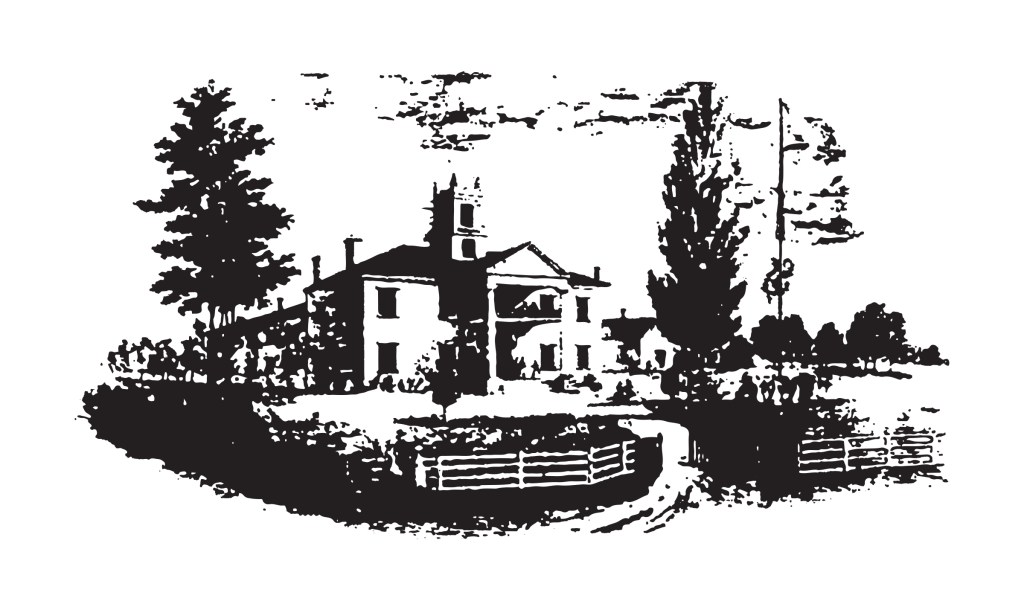
I hope you celebrated Independence Day with your family and friends. We have a lot to celebrate my friends as well. After three years of planning, fund-raising, and hard work, we are ready to begin the Female Institute’s Restoration!
Thanks to the success of our Tour of Homes, the generosity of the McCorquodale Foundation, grants from the Alabama Historical Commission, and financial gifts from our members, we have $500,000 to commit to this important restoration project. In the next few weeks, the updated architectural plans and the topographical survey of the Female Institute Complex will be complete, and we will be ready to begin construction.
This project will make a huge impact in our county for generations. Having an indoor facility with state-of-the-art facilities and exhibition areas to host community events, concerts, meetings, family events, and more will make the Institute the center of activity in Wilcox County once again. In addition, we will be restoring a part of the building that was removed in the 1970’s.
The success of our organization over the last five years has made this dream a reality. I must first thank our Board of Directors for their support throughout this journey. Time and again their wisdom and input have kept us on the right track. A huge thank you to each of the homeowners in Camden, Furman, Pine Apple, and Oak Hill who have opened their homes for our Tour of Homes. Your support and hospitality have made our Tour one of the largest and most successful in the country, raising tens of thousands of dollars for us. We could not have raised these funds without you. Thank you so much!
It is hard to believe that in the past two months we have raised nearly $200,000 for this project though both private donations and grants. As you will see in our financial report, this brings the balance in our accounts to over $600,000, much of which is generating interest as well. That represents an increase of over $400,000 in the last three years!
As exciting as the Female Institute Project is, you will see throughout this newsletter that the last twelve months have been extremely successful. From fascinating guest speakers to another successful Tour, a wonderful concert series to an expanded travel program this fall, we have so many programs/opportunities for our members and community to enjoy. Without a doubt we are making a difference.
I hope you will join us at our first meeting of the fall, Sunday, September 22, at 2:00 pm, at the Female Institute with our Guest Speaker Cart Blackwell. Cart will start the season off with “Art in Wilcox County – Past and Present.” Join us for what is sure to be a fascinating program.
Thank you all for your continued support of the Wilcox Historical Society. Together, we will make history this fall when the restoration of the Female Institute begins. I look forward to seeing all of you in September!
Sincerely,
Lance Britt, WHS President
2024 TOUR OF HOMES REPORT
Our Tour of Homes weekend March 22nd – 23rd showcasing sites in Oak Hill and Camden was an overwhelming success. From Friday night’s incredible Welcome Reception at RiverBend with guest speaker Laine Berry from Our Restoration Nation to the splendid weather Saturday, the beautiful homes and churches to Betty Kennedy’s amazing quilt collection, our guests experienced the best of Wilcox County.
We had over 900 people attend our Tour from twelve states! THANK YOU to our homeowners for their gracious hospitality, to our volunteers and sponsors for their support. Thank you, Frances and Billy Jones, as well for opening RiverBend both Friday night for the Welcome Reception and for the Tour.
Since 2017 our Tour has grown in to an event that draws nearly 1,000 people annually to our county. It has not only generated much needed funds for us and untold tax revenue for our county, but more importantly it has created a sense of community well beyond our county lines. The positive public exposure it has created for Wilcox County and Alabama is immeasurable.
Special Thanks to our 2024 Tour of Homes Sponsors!
Platinum Sponsors – Laine and Kevin Berry of Our Restoration Nation, The Brittany House Antiques at Oak Hill, Laura and Schley Rutherford and Town Country United Bank
Gold Sponsors – Garland Cook Smith, Eve Engle Kneeland and Nikki McGillvray
Silver Sponsors – Coast to Coast Hardware, Royal Restrooms
Bronze Sponsors – Black Belt Treasures Cultural Arts Center, Camden Jewelry and Gifts, Community Neighbor Bank, and Albritton’s Florist
Tour Sponsors – Holman Insurance, The Pecan Downtown
THE HOMES AND OTHER HISTORIC SITES
ON THE 2024 TOUR OF HOMES IN OAK HILL AND CAMDEN

OAK HILL
 Kennedy- Neumann House
The Dale-Kennedy-Neumann home, circa 1847, is a classic coastal cottage style house with numerous Greek Revival elements. It features a recessed porch supported by octagonal columns that rest on brick piers, a double front door with sidelights and transom, a triangular Greek Revival door surround and original nine over nine sash windows. This homesite was first bought by Dr. William Dale and his wife Mary Jane “Polly” Jones Dale. A large log house built by Wiley Williams was the first home built here. The Dales enclosed two rooms of the log house when building the home we see today. Years later the house was sold by Samuel Pressley Dale to Beck Kennedy and deeded to his son, Erskine and wife, Betty Gaines Kennedy. The Kennedys made many improvements to the home and were very active in the Oak Hill community. The home was added to the National Register of Historic Places as part of the Oak Hill Historic District in 1998. Dr Jay Neumann and wife, Allison.
 Jones-McWilliams House
The Jones-McWilliams home, circa 1846, was built by James Harvey Jones, Sr. and wife, Martha Elizabeth Harriss (daughter of Francis and Rose Harriss of Allenton). The timber for the house was cut from the surrounding land and the bricks made by enslaved labor on the lot. The house has six large columns across the front porch reaching to the second story. There are two large rooms on each side of the central hall of this coastal cottage home. A cross hall at the back of the central hall is used as a sitting room. The dining room and kitchen are in a central ell from the back sitting room. The double front door is surrounded by double tiered panes in the sidelights and transom. McWilliams family – the great, great, great grandsons of the builder.
 Twelve Oaks – the Kennedy-Griffin House
Twelve Oaks – the Kennedy-Griffin Home, c. 1920s, was built by Julia Clarke “Clarkie” Jones Dale, widow of Julius Clarke Dale, for their daughter, Evelyn Marie Dale after Evelyn’s marriage to Wesley Beck Kennedy in 1925. Twelve Oaks is a Colonial Revival house featuring a front recessed porch, two interior brick chimneys, two dormers on front facade with a south side bay window and attached porch along with multi-level, wide porches on the back to enjoy a splendid view of the backyard. The property also features beautifully landscaped grounds. Ivey and Angie Griffin.
 Fox-Harris-Jones-Mitchell House
Dr. Daniel Jesse Fox and wife Louisa Ellen McConnico Fox built this home about 1845. By 1870 the Fox family moved to Marion County, Illinois. Dr. Elbert Harris and wife Sarah Hawthorne Coleman Harris bought the house from Dr. Fox. Next Dr. Joseph Harvey Jones and wife Sallie Hall Hines Jones were the owners. Sallie died in 1886 and Dr. Jones married Jessie Taylor Bonner of Rosebud in 1889. As a young twenty-year-old bride, Jessie Jones made some changes to the house. The house originally had two ells off a wide front porch. Each ell and the front porch had big columns across them. There were two large rooms with dividing pocket doors in each ell. The ceilings were beautifully decorated with plaster medallions. Four large rooms and a center hall made up the main part of the house. The dining room and kitchen were in an ell on the left of the back porch. Mrs. Jones had the big columns across the front replaced with smaller turned posts. The left ell was torn down and sold. The Greek Revival style / Victorian updated frame central passage coastal cottage type house has received an extensive renovation by new owners, Bill and Jennifer Mitchell. Many original interior features remain – pocket doors, ceiling medallions, heart pine floors, moldings and wainscotting. The setting of this home on a hilltop gives a view of about eight miles!
 Oak Hill School / Bethel ARP Church Annex
The Oak Hill Schoolhouse was built about 1926 by the Works Progress Administration. It housed grades 1-6 until it was closed in the 1940s and the students were bused to Moore Academy in Pine Apple. The building was given to the Town of Oak Hill who improved and maintained it as a community center until it was sold to Bethel ARP Church in the 1960s. Most of the rural schoolhouses have been demolished or fallen into disrepair but thanks to the Town of Oak Hill and the ARP Church, this space has been well maintained and continues to be an important part of the community. During the Tour the school house was filled with 80-100 quilts by the renowned Wilcox County quilter, Betty Gaines Kennedy. Since she began quilting 18 years ago, Miss Betty has made over 150 quilts. In addition to the quilts displayed, she has donated 14 quilts to charities and institutions including Relay for Life, J Paul Jones Hospital, and the Monroe County Hospital and Museum. These raffled and auctioned quilts have raised over $10,000 for associated institutions and causes. Betty’s style of quilting is best defined as traditional. While working from historic patterns such as the Dresden Plate, Log Cabin, Irish Chain, Sunbonnet Sue, Double Wedding Ring and many others, Betty demonstrates her artistic sensibilities through her amazing use of color and contrast. She incorporates applique on many of her quilts, using a method she has perfected and is frequently asked to share. Betty is an active member of quilting communities both local and regional, teaching classes, giving lectures and demonstrations, and sharing her knowledge and expertise whenever possible.
 The Brittany House Antiques
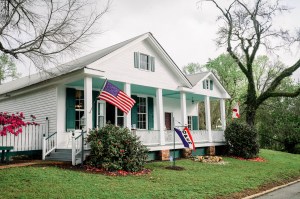
The Brittany House Antiques, c 1878, was built as a general store for brothers, John Taylor Dale (1842-1935), Alvin Miller Dale (18501927) and Julius Clarke Dale (1853-1909.) It was later purchased by brothers James Boroughs Dale (1902-1983) and Julius Alvin Dale (1904-1992.) The store was known as the Dale Brothers Store. In the 1970s the store was operated as an antique store by Bettie Byars and Ruby Griffin. In 1999 the building was restored by David and Mildred Watson and it became an antique store again along with a short-lived restaurant called The Cotton Boll. After sitting vacant for nearly 16 years, current owner Lance Britt purchased the building in 2018 and created The Brittany House Antiques at Oak Hill. The shop specializes in American, Continental, and English furniture as well as silver and porcelain displayed on the original general store shelves. The shop has been featured in Alabama Magazine, Victoria Magazine and on AL.com.
 Bear Creek Baptist Church
Bear Creek Baptist Church, near Oak Hill in Caledonia was admitted to the Bethlehem Baptist Church Association in 1835 with 46 members. In 1845 there were 22 baptisms at Bear Creek, and in 1848, 16 were baptized. In 1850 the Pine Barren Baptist Association was organized and commenced the session with the Bear Creek Church on the Saturday before the third Sunday in October 1850. At that time Bear Creek had 60 members. Reverend Hugh G. Owen was pastor. His pastorate lasted 22 years. In 1877 Bear Creek led the association in baptisms with 21. It did so again in 1881 with 27 baptisms reported and a membership of 105. Reverend A. A. Sims was pastor. Mr. D. P. Watts became church clerk in 1885. He held that position for the next 64 years until his death in 1949. He was also treasurer for many of those years. The Jones, Philpot, Sadler, Sheffield, Turner, Watson, Watts families and others were all actively involved in the Bear Creek Church. The Bear Creek Church record was last included in the 1962 associational minutes with a membership of 38. The present Bear Creek church building was built in the late 19th century. The high pitch of the gable roof, as well as the original tongue and groove indicate a late Victorian date. However, the four-column front is reminiscent of Greek Revival. The columns rest on cut stone piers as does the entire church. The front has two doors and there are six windows on each side. The style is considered neo classical revival. The church has recently undergone an extensive renovation with a grant from the Alabama Historical Commission. Bear Creek Cemetery was added to the Alabama Historic Cemetery Register in 2013. The cemetery dates to 1880 with the oldest tombstone being that of Margaret Sessions Watts. There are two historically significant grave shelters or houses which were recently restored. There are over 200 graves in the cemetery with some unmarked as an area of the cemetery was used as a potter’s field. There are many graves of veterans – fourteen known Confederate veterans, three known WWI veterans and seven known WWII veterans.
 Bethel Associate Reformed Presbyterian Church
Bethel ARP Church is a continuation of old Lebanon Church which was in Hamburg, near Allenton in Wilcox County. The exact date of Lebanon’s organization is not known, between 1822 and 1828. In 1856 it was decided by Lebanon’s members to divide into two churches, one retaining the name of Lebanon and moving nearer Camden in the Shawnee community and the other chose the name Bethel and was built in Oak Hill. Rev. John Miller came with Bethel as it first pastor, remaining 31 years until his death. In 1895 a group of young girls, Mattie Voltz and Joyce Jones, Euphemia and Sara Henry, Lois and Sara Dale, Emma Young and Bertha McWilliams, asked Miss Dannie McWilliams to organize them into a society to build a new church. The present church building is a result of their efforts! It was dedicated on 9 November 1895. Bethel ARP Church is described as a late Victorian frame front gabled church with a tower in the southwest corner and detached wing with breezeway, decorative shingling in the gables; above both windows in the gable are semicircular windows with multiple square stained glass-colored panes, tower is two storied with pyramidal steeple and four decorative pediments supported by brackets. Added to the National Register of Historic Places as part of the Oak Hill Historic District in 1998, Bethel Church continues a tradition of Associate Reformed Presbyterian influence on this area. The Associate Reformed Presbyterian Church is the oldest Presbyterian denomination in America.
CAMDEN
 Bagby-Beck-Liddell-Burford House
Arthur Pendleton Bagby, tenth Governor of Alabama (1837-1841), U.S. Senator (1841-1847) and Minister to Russia (1848-1849), moved to Camden in 1853. Prior to his arrival Bagby contracted with Henry Francis Cook, a New Englander living in Camden, to build his home “befitting a man of his position.” The agreed upon price of $3,750 was to be paid in three installments. Unfortunately, Bagby could not make the payments and the property was sold at public auction to Thomas King Beck, to satisfy Mr. Cook’s lien. Thomas King Beck and his brother Franklin King Beck, were nephews of Vice President William Rufus King. The house was purchased by John Russell Liddell Sr. of Ohio in 1896 and was for many years the home of Will and Viola Goode Liddell, a celebrated Alabama author. In 1998 the house was purchased by Peyton Daniel Burford III and wife, Missy George Burford. The two-story antebellum home, c. 1847, features square box columns, a hallmark of Cook, and has supporting timbers which are secured by morticed joints and wooded pegs. The floors are six-inch heart pine.
 Jones-McIntosh-Hicks House
Richard Channing Jones, a native of Virginia, married Marcella “Stella” Hamilton Boykin in 1864 and later purchased this site on Broad Street in Camden to build their home about 1869. He graduated from the University of Alabama in 1859, was admitted to the bar in 1861 and was an active figure in Alabama public life, serving as brigadier general of the militia for several years and also as a member of the State Senate. In 1890, he was called by the trustees to the presidency of the University and during his tenure the Capstone saw many advances. Dr. Jones’ administration saw the launching of the Crimson-White, the Corolla (1893), the opening of the University to women students and the beginning of football (both 1892.) The house was later the home of Dr. Edward LeRoy McIntosh and wife, Grace Robins Pharr, and their family. Dr. McIntosh was born in Camden in 1877 and was the namesake of Dr. Edward LeRoy McDaniel who practiced medicine in Camden for many years. Dr. McIntosh received his undergraduate degree from the University of Alabama and his medical degree in 1901 from Emory University. He moved to Catherine and was a general practitioner – a typical country doctor, for a number of years, traveling on horseback over an area extending from Lamison to Gee’s Bend. He became Health Officer of Wilcox County in 1928 and served until that capacity until his retirement in 1958. Current owner, Lucy Hicks, purchased the house in 2008.
 RiverBend – Bell-Moore-Jones House
River traffic was flourishing when Joseph Bell and wife Martha Jones, sister of Richard Channing Jones, built this house in the late 1840’s. The house, occupied by the Bells until his death in 1879, was an impressive manor for his large cotton plantation. It was originally perched on a bluff overlooking the river and was moved to its present site not long after its completion. Later the home was purchased by William Wirt Moore, prominent owner of Bridgeport Landing, Camden’s most influential river port. He operated the landing under the name of Moore and Holman Company, a partnership with his brother-in-law B.O. Holman. Holman died due to wounds received at the Battle of Gettysburg. Moore operated the Bridgeport Landing for more than fifty years. RiverBend is a palatial interpretation of a country residence, complete with a Carolina-style porch, heavy Gerek woodwork, ornamental plaster, and remarkable antiques. Over 6,000 square feet the home features sixteen-foot-tall ceilings, two large formal rooms flanking a front hall and four bedrooms. Previous owners, Chris Bailey and Ryan Dunagan, restored the main house and added two large rear wings and reinstated formal gardens and grounds. Joseph W. “Billy” Jones and wife Frances

Save the Date!
Wilcox Historical Society Tour of Homes March 21-22, 2025 Camden, Alabama
Tickets will be available on eventbrite.com December 1, 2024
 to new members from Alabama: Camden – Marilyn Ammons and Donna McGraw, Fairhope – Alieze Capell, Montgomery – LuAnn Cobb, Theodore – Dan Cornelius, Birmingham – Anthony and Diane Cuicchi, Greensboro – Eve Engle Kneeland and Nikki McGillvray, Demopolis – Lynn Little, Minter – Terri Wilkinson Little and from Whatley – Sherry Sprayberry. And welcome to new members Joel Edward Bonner II and Nicholas Clarke from Ranch Mirage, CA and Oliver and Jennifer Gore of Pensacola, FL.
WHS Meetings
DOWN HOME IN THE DEEP SOUTH –
THE ARCHITECTURE OF WILCOX COUNTY
Wilcox County has long been recognized for its unique architecture and culture. Our May 2023 meeting, Down Home in the Deep South: The Architecture of Wilcox County, examined two hundred years of building in one of the most beautiful places in the American South.
The presentation by Cart Blackwell examined architectural styles, building types, construction methods, building processes, local figures (clients, builders, artisans, etc.) and much more.
 Examining both demolished and extant structures, with their attendant landscapes, this presentation celebrated the historical and continued importance of architecture in Wilcox County. Cartledge Weeden Blackwell, III, “Cart,” is an architectural historian and the curator of the Mobile Carnival Museum. Blackwell was born in Selma, Alabama. He obtained undergraduate degrees in art history and historic preservation from the College of Charleston and his MA in Architectural History from the University’s School of Architecture. His scholarly focus is the art and architecture of 19th century and 20th century America, particularly that of the Southeast.
ALABAMA TREASURES – GAINESWOOD AND MAGNOLIA GROVE, THEIR CONTENTS AND PEOPLE
Sarah Duggan, manager of the Decorative Arts of the Gulf South Project (DAGS) at The Historic New Orleans Collection, shared with us the history of two of Alabama’s finest homes and the treasures they hold. The September 2023 meeting was held at the Wilcox Female Institute. Sarah and interns with the Decorative Arts of the South Project spent two summers documenting the collections at each home – Gaineswood (in Demopolis) and Magnolia Grove (in Greensboro), adding them to the DAGS research database in New Orleans. Both homes are owned by the Alabama Historical Commission and are open to the public.
As you may recall DAGS spent the summer of 2016 documenting several homes in Wilcox County.
ANTIQUES IN ALABAMA
Antique expert, master cabinet maker and interpreter Christopher Lang of Huntsville, was our featured speaker for the October 2023 meeting. The topic was Alabama Antiques.
Using maps, estate inventories, photographs, and paintings, Mr. Lang depicted the rich and diverse traditions of the Alabama cabinetmaking trade. He shared examples of Alabama made 19th century furniture found in homes in Huntsville, Anniston, and Montgomery.
Mr. Lang included a hands-on component following his talk and allowed WHS members to bring photos of their personal antiques for evaluation.
THE DISCOVERY OF THE CLOTILDA, THE LAST SLAVE SHIP
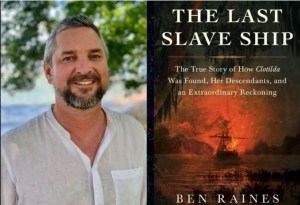 In November 2023 we were pleased to have guest speaker, Ben Raines, author of – The Discovery of the Clotilda, the Last Slave Ship. “The incredible true story of the last ship to carry enslaved people to America, the remarkable town its survivors founded after emancipation, and the complicated legacy their descendants carry with them to this day—by the journalist who discovered the ship’s remains.
Fifty years after the Atlantic slave trade was outlawed, the Clotilda became the last ship in history to bring enslaved Africans to the United States. The ship was scuttled and burned on arrival to hide evidence of the crime, allowing the wealthy perpetrators to escape prosecution. Despite numerous efforts to find the sunken wreck, Clotilda remained hidden for the next 160 years. But in 2019, journalist Ben Raines made international news when he successfully concluded his obsessive quest through the swamps of Alabama to uncover one of our nation’s most important historical artifacts.”
CHRISTMAS CONCERT IN CAMDEN
A Classy Christmas Concert in Camden was held on Saturday, December 16th, 2023. The joyful sound of the Advent season with the Harvest Arts Chamber Quarter was a fusion of Christmas carols and Classical music, featuring arrangements by Madeline Cawley.
Featured artists were Madeline Cawley, Flute; Josèe Klein, Violin; Tim Richardson, Viola and Ethan Blake, Cello. The concert was held at the Camden ARP Church.
THE LIFE OF RICHARD ERVIN MCWILLIAMS
 The WHS met on Sunday, March 3rd in Camden at the Sterrett-McWilliams house. Our speaker was local historian and teacher, Anne Farrell Wright. She spoke on highlights of the life of Richard Ervin McWilliams, (1842-1912), esteemed local merchant and ancestor of many of our members.
The Sterrett-McWilliams house is now owned by McWilliams’ descendants Lindsay Cook and Garland Cook Smith.
Inspired by various pattern books, this outstanding example of antebellum eclecticism was built in 1851 for Judge David W. Sterrett, lawyer, planter and trustee of the Wilcox Female Institute, and his wife, Susan McConnico. The veranda features four tall trellis like supports, scroll cut balustrades and an unusual parapet. Inside, a central foyer contains twin spiral cantilevered stairways, red glass sidelights and transom and double parlors with heavy decorative plasterwork. In 1870, Sterrett’s daughter, Sally Brooks Sterrett Tate, sold the house to Mr. McWilliams.
CARLOWVILLE
 Members of the WHS traveled to the Dallas County community of Carlowville for our meeting on Sunday, April 28 and visited two of the contributing properties in the Carlowville Historic District.
The meeting was held at St. Paul’s Episcopal Church, which was built in 1838. WHS members George and Mary Margaret Kyser gave a short history and tour of St. Paul’s and its Parish House.
Members were then invited a short distance down the road to the Rumpt-Alison-Bowers House, built in 1840, where we were greeted by owners and WHS members Patricia and Linn Pritchett.
WHS 2023 CHRISTMAS OPEN HOUSE IN FURMAN
 Our annual Christmas open house was held the afternoon of December 2, at historic Laura Ann, the Furman home of WHS members Kent and Laura Tabor. Laura Ann, c. 1860, underwent an extensive renovation by the Tabors starting in 2018. The home was unofficially voted the Crowd Favorite when opened for the 2022 Tour of Homes. What a delight to enjoy the magnificent Christmas decorations at Laura Ann!
The following week, photographers for Victoria Magazine photographed the home which will be featured in the December 2024 issue.

Daniel Lee “Dan” Albritton June 8, 1936 – April 1, 2023, was born in Camden and graduated from Wilcox County High School. Dan left Camden in 1954 to attend Georgia Tech in Atlanta and graduated with a BS in Electrical Engineering. Dan and his high school sweetheart, Vera Elizabeth Bigger, were married in the Camden Baptist Church in 1959. After graduating in 1967 with a PhD in Physics from Georgia Tech, Dan and the family moved to Boulder, CO where they lived the remainder of their lives. Dr. Daniel Albritton spent nearly 40 years as a scientist and administrator working to understand the chemical processes of the atmosphere and their implications for the health of living creatures and their effect on the global climate system. He was head of NOAA’s Aeronomy Laboratory from 1986 until his retirement in 2006. Dan was the father of three children: Daniel Miller Albritton, Eliz Albritton-McDonald and Vivian Albritton Cox. He was preceded in death by his parents; Jessie McDaniel Albritton and Lena Tucker Miller and his wife Vera. He is survived by his two brothers, Haas Strother and Lee Albritton.
Erskine Grier “Don” Donald III, April 25, 1940 – August 10, 2023, was born in Greenville, Alabama and grew up in Pine Apple. Don was a 1958 graduate of Moore Academy and majored in Aerospace Engineering at the University of Alabama graduating in 1962. After graduation he accepted a position with NASA and began his career in Hampton, VA. In 1963 he married Mary Charles Turberville and they moved to Huntsville, AL where he was employed by NASA and worked extensively on the Saturn V rocket that was instrumental in the Apollo moon missions. After the Apollo missions, he was involved with the Space Shuttle program and the Hubble space telescope. Upon retirement from NASA in 1992, Don moved back to Pine Apple with Mary Charles and continued a full-time career as a land broker for Great Southern Land Company. In addition to his work with the Alabama Baptist Historical Commission, Don served as deacon chairman at Bethsaida Baptist Church in Furman and was instrumental in moving the first home of The Alabama Baptist to the church grounds in 2022 for preservation as part of the Furman National Historic District. He was very active in the Wilcox Historical Society and served as president for many years. Don is survived by his wife of sixty years, Mary Charles Donald and three sons: Donny, Brooks, and Scott. He was preceded in death by his parents; Erskine Grier Donald, Jr. and Flora Ledbetter Donald and his brother, William Harris “Bill” Donald.
Nimrod Thompson “Rod” Frazer, December 10, 1929 – March 7, 2023, was born in Montgomery, AL. He graduated high school at Wilcox County High School in Camden. While still in high school he enlisted in the National Guard. He served the U.S. Army from 1950-53 and was a Tank Platoon Leader in the Korean Campaign. Rod received his B.A. from Huntington College; attended Columbia University in 1953-54 and received an M.B.A. from Harvard Business School in 1956. Through his work with the Croix Rouge Farm Memorial Foundation, he commissioned four bronze sculptures from sculptor James Butler of the British Royal Academy. Two of them called The Rainbow Soldier honor his father and his fellow soldiers in the 42nd Rainbow Division. One stands in France and the other in Montgomery. He also commissioned a second casting of Daedalus for Maxwell Air Force Base, dedicated to the American Fliers in WWI and to his mother, who had worked at Maxwell. His final commission was Return from the Argonne in honor of all soldiers who found in the Meuse Argonne campaign. Rod began his investment banking career at Sterne, Agee and Leach. In 1976, he and Clifford Lanier started the Frazer Lanier Company. In 1974, Rod with other partners at Thornton Farish and Gauntt joined H.G. Pattillo of Atlanta to form Industrial Properties Inc. A published author, he focused on military matters and his book Send the Alabamians: WWI Fighters in the Rainbow Division that was written to honor the service of Alabamians in France in 1918 became a classic and best seller. He later wrote The Best World War I Story I Know, on the Point of the Argonne. He was married to Patricia Lee Martin. Their five children are: Thomas Martin Frazer, Nimrod Thompson Frazer, Margaret Frazer Proctor, Sarah Hunter Frazer, and John Riley Frazer. He was preceded in death by his parents; Margaret Thompson Frazer Winkler and William Johnson Frazer and grandparents Nimrod Washington Long Thompson and Lula Slaton Thompson.
Gail Jeanette Morris Fuller November 14, 1942 – June 7, 2023, was born in Duncanville, AL. Gail graduated from Tuscaloosa County High School in 1961 and from the University of Alabama. She taught school at Jacksonville State University, Selma High School and other Selma city schools, Wilcox Academy and at Wilcox County High School. She also served as postmistress at the Oak Hill Post Office for several years. Gail was a faithful member of Bethel Associate Reformed Presbyterian Church in Oak Hill where she served as Sunday School Treasurer, church librarian and as an active participant of the Women of the Church (WOC). In 1977 she married Felix David Fuller and moved to Oak Hill. Gail is survived by her husband, David Fuller, and daughter Jeannie, aka Kathryn or K. Merris Scott. She was preceded in death by her parents; Ernest Roy Morris and Elvin Morris and her brother, Tyrone Morris.
Harold Watts “Hal” Grimes Jr. August 1, 1930 – February 26, 2024, was born in Greenville, AL. and grew up in Pine Apple. Hal was a descendant of early pioneer families that settled western Butler and eastern Wilcox counties. He graduated from Moore Academy in 1948 and from A.P.I., now known as Auburn University, with a B.S. in Agriculture in 1952. Hal married his high school sweetheart, Virginia Dell Lamkin in 1952. He served the U.S. Army in the Korean Campaign. After his discharge, he returned to Auburn University for his Master’s Degree in Agronomy which he received in 1957. He began his ag career at Auburn University’s Black Belt Substation in Marion Junction, AL. After over three decades of service to Alabama agriculture he retired from the Alabama Agricultural Experiment Station system. He and Virginia returned to Pine Apple where he was a cattle farmer until 2017. Hal was always active in Pine Apple and Wilcox County and was instrumental in securing and restoring Moore Academy for the Moore Academy Alumni Association. He was preceded in death by his parents; Harold Watts Grimes and Frances Donald Dudley Grimes and brother, Hugh Joseph Dudley. He is survived by his wife of nearly seventy-two years, Virginia and children, Harold Watts Grimes III, William Allen “Bill” Grimes, and Martha Grimes Lampkin.
Tennant Schultz “Ten” McWilliams September 12, 1943 – October 23, 2023, was born in Birmingham, AL. He graduated from Indian Springs School and was a history major at Birmingham Southern College in 1965. He secured his M.A. at the University of Alabama in 1967 and the PhD in diplomatic history at the University of Georgia in 1973. He was longtime Dean of the School of Social and Behavioral Sciences at the University of Alabama in Birmingham and a widely published Southern historian. His latest book published in 2023 was titled Dixie Heretic: The Civil Rights Odyssey of Renwick C. Kennedy. His earlier work, “New Lights in the Valley: The Emergence of U.A.B.” was hailed as a major contribution to the study of urban universities and their transforming impact on American cities. As a UAB professor and administrator, he was part of that transformative process in Birmingham, recruiting scholars whose work reflected his interests in the rigorous, open-minded study of history, politics, and civil rights. He published widely in professional journals, and pursued his interest in unique Southern personalities in four books: The Chaplain’s Conflict: Good and Evil in a War Hospital, 1943-45, Hannis Taylor, the New Southerner as an American, A New Day Coming, Alabama and the Problem of Change, 1877-1920 and The New South Faces the World; Foreign Affairs and the Southern Sense of Self, 1877-1950. He was preceded in death by his parents; Richebourg Gaillard McWilliams and Dorothy Schultz McWilliams. He is survived by his wife of twenty-six years, Susan; his brothers, Richebourg and Burk; his children Lauren Lanier Wainwright, Danielle, and Jason Vacca McWilliams.
William Dudley “Billy” Melton June 30, 1943 – October 10, 2023, was born in Greenville, AL and grew up in Evergreen. He was a descendant of the earliest pioneer families that settled western Butler and eastern Wilcox Counties. He graduated from Evergreen High School in 1961 and signed a football scholarship with Auburn University and played on the freshman team of 1961. He graduated in 1964 and was a life member of the Auburn Alumni Association. He entered the University of Alabama Law School in 1963, graduated in 1966 and after graduation he was employed by the Office of the Attorney General. He served in both the Alabama House of Representatives and Alabama State Senate. Billy was a trial lawyer for nearly fifty years. He also served as Judge on the Alabama Court of the Judiciary for many years. He was a lifelong member of the Evergreen Baptist Church. He was preceded in death by his parents; Thomas Plowden Melton, Jr., and Eulynne Brantley Melton. He is survived by his wife of fifty-six years, Nancy Miller Melton, and their two children: Nancy Dudley Melton Berry and Richard Lowden Melton.
Marileta Powell Stone August 2, 1929 – December 18, 2023, was born in Selma, AL and lived most of her life in Wilcox County. Marileta graduated from Moore Academy in Pine Apple in 1947 and from API, now Auburn University in 1951. Marileta grew up as a member of Ackerville Baptist Church and was the last person baptized there, around 1941, shortly before it closed. In 1952 she married William Edward “Eddie” Stone, Jr. of Pine Apple. She was an active bridge player and enjoyed sewing and cooking for her family. Marileta and Eddie were active members in Friendship Baptist Church in Pine Apple. She was preceded in death by her parents; Calvin Elias Powell, and Leta Rikard Powell of Ackerville, AL and her husband, Eddie. She is survived by two daughters: Debra Whatley, and Kathy Perryman.
Harold Eldred Swearingen July 26, 1926 – May 1, 2024, was born in Pine Hill, AL and was a life-long resident. He graduated from Pine Hill High School in 1944 and enrolled in the University of Alabama, but his studies were interrupted when he was called for military service during WWII where he served in the U.S. Army Air Corp. He resumed his college studies and graduated in 1949 with a degree in finance. He married Ann Philips of Attalla, AL in 1950 and they established their home in Pine Hill. He entered the insurance business with his father at the Swearingen Insurance Agency and for over forty years he ran a successful agency. He served as Mayor of Pine Hill for twenty-six years and was a leader of many projects that had an impact throughout the region, most notably was the locating of the MacMillan-Bloedel Paper Mill (now International Paper) and the Pine Hill Water Treatment Plant. He was a life long member of the Pine Hill Baptist Church where for decades he served as deacon. He was preceded in death by his parents; Frank Eldred Swearingen, and Ruth Adams Swearingen and two sisters, Geraldine Jones, and Emily Hart. He is survived by his wife, Ann and their three children, Suzanne, Burke, and Cynthia.
EARLY RIVER DAYS IN WILCOX COUNTY
(Part 3 and final)
A paper by Viola Liddell given for the Wilcox Historical Society, March, 1968
During the war many of these boats were cut down, armed, and made into blockade runners. Many were captured by the Yankees, their cargoes taken and the boats burned. As Alabama recovered from the war, the river traffic and travel boomed again – only to gradually recede and disappear as the railroads took over.
Though the iron and steam monsters which came thundering through the land gradually displaced the River Queens, they could not erase the memories of these gentler, water-bound travelers. But as the years of the nineteen hundreds marched along, the river’ s usefulness so retrogressed until the stream was considered more of a nuisance than a boon, a formidable barrier slicing the county into two parts, and a devilishly crooked line for school children to reproduce from their geography maps.
Even after men learned to throw the abundant gravel lying beside the roads down into the quagmires of mud and render them passable, the river still had to be crossed, and the few bridges that were constructed spanned the river at strategic sites, usually on the door-steps of cities. So, until 1931, when the Lee Long Bridge was built, there were only two ways to cross the Alabama River in Wilcox County – by skiff when the stream was out of its banks or by ferry when it was within them.
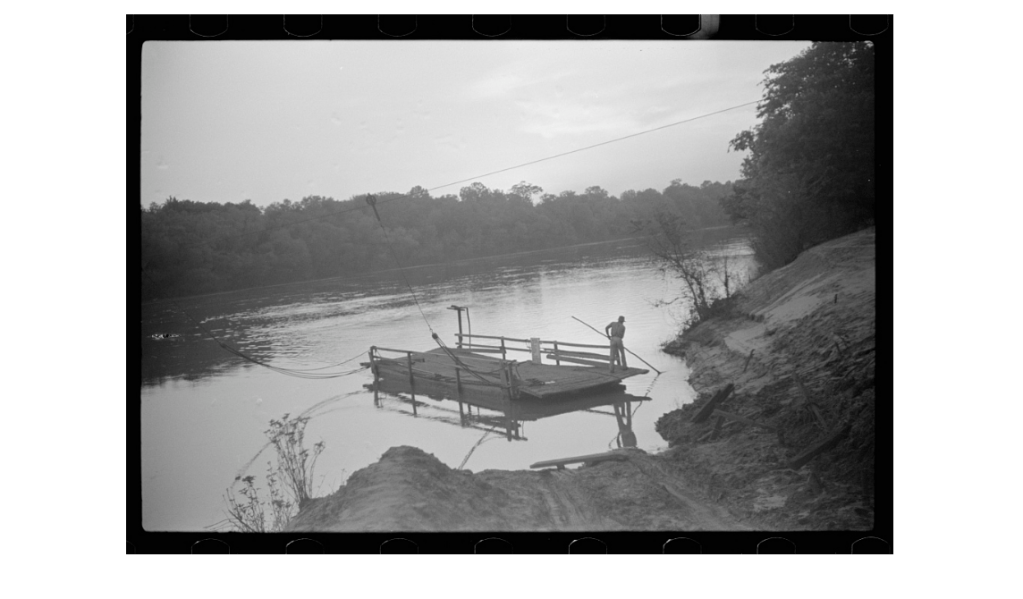
Well do I recall how negotiating the steep, treacherous banks and manipulating the deliberate, cable-guided, current-propelled flat-boat, required half an hour if the current was strong and the barge-like boat was on the right side of the river – the right side being the side on which you happened to be on arrival. But if the flat happened to be on the opposite side, or if the current was sluggish and poling was necessary, or if the ferryman had to be hallooed out of his sleep, then crossing could hardly be accomplished in an hour. And if one got stuck on the muddy bank or slipped in a ditch, he might spend the day or night there hopelessly bogged down in axels waiting for a team of mules fetched from the nearest plantation to drag him free.
Vivid in my memory is a picture of my father preparing on a cold winter day for this twenty-mile trip from our home to the county seat of Camden: a team of horses hitched to his buggy, storm curtains up, father practically cocooned in over-coat, ear muffs, and gloves lined with rabbit fur. Over his knees was a heavy lap-robe, mother putting heated bricks wrapped in flannel into the foot of the buggy for keeping his feet warm, and father making sure he carried a nip of Four Roses in his pocket with which to fortify his benumbed body later in the day.
These trips – to serve on the jury, to consult a lawyer on legal matters, to pay his taxes, to attend a funeral, or to get the political lay-of-the-land – were, in the winter time, with prairie mud often hub-deep, sun-up to sun-down excursions with the river always a formidable barrier mid-way. If lucky, Father would arrive in Camden by mid-afternoon, take his team to the livery stable, and settle down either with a friend or at the pleasantly verandered little Boltz Hotel to stay until his business was attended to.
But if, when he set out, the river was out of its banks, arrangements had to be made by some other traveler that he met from the other side, his buggy and team returned home by a driver, and then taken across river by skiff with a good paddle-man who could out-maneuver the treacherous current. And woe to anyone getting caught across river by flood water – the team would be stranded and the trip back would be a two-day one of seventy cindery, snail-slow miles by rail, broken by a night’s lay-over in Selma.
One of the greatest dangers of crossing the river in those days was that the horses or mules in transit might become frightened and back off the flat or charge forward into the restraining timbers thrown across the forward end of the flat, either to injure themselves or damage their vehicles. And the danger of losing one’s conveyance not only did not lessen but actually increased with the advent of the gasoline buggy.
To the ferryman these balky and contrary contraptions were for many years the bane of his existence. They frightened the animals hitched to any drawn vehicles taken onto the flat in their company, so that rearing and plunging animals were a commonplace danger. The drivers, no more adjusted to manipulating these new machines than the horses to confronting them, were forever hitting the flat too hard coming on and kicking it out from under the hind wheels, which inevitably burrowed into the ever-wet earth, subsequently having to be bodily lifted or pried out.
Or the brakes would fail to hold or the driver forget to put them on – or put his foot on the accelerator instead, the machine dashing across the flat and crashing the protecting timbers. Occasionally the barrier would fail to hold, and the car would plow through it and plunge into the river. The driver was usually able to scramble out – not a difficult feat since the cars were open – and by means of wench, cables and super human effort he was usually able to salvage his water-logged machine.
One such incident proved a sad climax to an otherwise happy occasion when an inexperienced driver with his first car and a new and overly trusting wife, who chose to ride rather than walk on the flat, crashed the barrier and plunged into the river. As the bride-groom extricated himself from the car and climbed onto the flat, he saw his bride floundering in the water nearby, apparently on the verge of drowning. Either from fright or his inability to swim – it is not known which – the young man made no effort to rescue his wife, but instead snatched a dollar bill from his pocket and waving it in the air, screamed to the ferryman and other passengers aboard the flat, “Save my wife! A dollar for my wife! A dollar for my wife!”
Extending his pushing pole out to the victim, the ferryman so easily rescued the dripping and sputtering bride that even the one-dollar reward was with-held until laughing passengers demanded it be paid. Then, as one onlooker afterwards related it, the irate bride, vowing she’d not be caught dead with a man who valued her life so lightly, took off her new shoes and in spite of apologies and remonstrations from her mate, stoically set off for home as fast as her two feet could take her.
To the danger of getting onto and off the flat was often added the danger of getting up or down the steep and often muddy banks. Because of this danger and the good sense of lightening the car’s load, most passengers left their vehicles at the first declivity and did not reenter them until their drivers had brought them safely to the top of the opposite bank.
Because of such precautions, more than one man became involved in a dilemma that sent them to the dog-house for days. One such occurred in my own family. Mr. Berry, a brother-in-law, and his none too slender wife, Mamie, as we called her, were crossing over. Distrusting both her husband’s driving and the car’s ability to get up the river bank with her inside, Mamie walked down the near bank and after the flat was moored, began to puff up the opposite bank. Mr. Berry did what was customary, gave his car the juice, bounded off the flat, and striving to stay in the ruts by never slackening his pace, sped up to level ground without mishap. But so concerned had he been with maneuvering the car and accomplishing his goal, that he joyously raced fifteen miles down the road to Camden, completely unaware of Mamie’s predicament. Arriving home, he was met by his son whose first words were, “Papa, where’s Mama?”
“Where’s Mama?” he repeated vacantly. Then remembering – “Good Lord!” he exclaimed – dashing out of the house – “Where is Mama?”
It was a good question, and one which was often repeated through the years – always to Mr. Berry’s chagrin and dismay.
The placid canoe days long a legend, the grand days of the steamboats a faded glory, the hazardous ferry days a welcome past, cars began in the great depression days to slide over a slim rainbow of concrete and steel as smoothly as water drops slide down a window pane. For travelers the Alabama was at last impotent – no longer a divider of our county – at last she had become a sort of Sleeping Beauty –calm and quiescent except in flood times – offering little more than a field for the lonely fisherman to play his trade and the motor-boats to scitter about for fun and pleasure. However, there were a few visionaries, day-dreamers, even in those years who knew that The Alabama was not really a Sleeping Beauty but a Sleeping Giant instead. One who would someday be wakened and whose powerful sinews would be harnessed to shake and remake this quiet, drowsy land of ours.
Today this dream has become a fact, and what we shall be like in the future because of this awakening can hardly be imagined, much less predicted. But most of our river front will become shores of a great lake, playgrounds will offer recreation, sport, and relaxation to thousands of people from all over the land, factories and mills and elevators and inland docks will abound, fishing and boating and surfing and camping will be everyman’s sport, flood will abate (or so we are told) and barges and tugs and even pleasure boats will jam the traffic lanes. Camden will boom and become a city – our land, our forests, our minerals will become priceless – people will come to work and come to play and come to live and to stay. They will change us more than we will change them perhaps, and in due season we will no doubt lose a large proportion of our Negroes who are even now in great numbers having to leave the land, and we will then become a predominantly white area of our state. Many changes are ahead of us, some will be for the best, but there will be ill mixed with the good, and we will be sorely tested to preserve the cherished mores of our past.
But like the great father of waters, our own Alabama River will just keep rolling along – and as she has made us, perhaps we can hope that through the precipitous changes ahead she will also save us.
NOTE: I wish to give credit to the late Mr. Bert Neville of Selma for some of the information about the early boats on the Alabama River, and to Judge Fleetwood Foster for his first-hand accounts of boat travel and races and accidents that occurred in Wilcox County waters. These accounts were first published in the Wilcox Banner and later compiled into a booklet by Mr. Bert Neville. The latter accounts were personal and participated in by myself in my early life.
Editor’s Note – Photo from the Library of Congress titled Cable Ferry from Camden to Gee’s Bend, Marion Post Wolcott, Photographer, May 1939.
Reaves Chapel Church
By Jackson E. Knight Jr., Mexia, Alabama
There are many old churches in South Alabama that I visit and have written about, or I am researching to write about. Of all that are out there though Reaves Chapel in Southern Wilcox County holds more prominence for me than any other I can name. It does so for several reasons. First off, my father, Grandparents, Great Grandparents, and Great, Great Grandparents, are all buried there. Not only them but numerous other people who have influenced or been a part of my life in some way.
From my earliest childhood I remember visiting the cemetery there and going through it with my Great Aunt who is also buried there. One of my greatest regrets I have in life right now is that I cannot remember the stories that she told me about the people that she knew that are buried there. Unfortunately, I was too young and there were too many to get.
As always, I am searching for information and history on things of old. Recently I was able to get my hands on some information on Reaves Chapel Church and Cemetery. There is a pamphlet compiled by a lady by the name of Florence Lambrecht Swanson that I was able to read some information from that she had compiled. I was immediately enthralled by this particular piece of information because as I was reading through it, I saw two names that immediately jumped out at me. The name of Minnie Knight Jordan, and Will Knight. Minnie Jordan being my Great Aunt that I had stayed with as a preschooler, whom I had walked the cemetery with many times hearing the stories of the folks that were buried there. Will Knight was of course my grandfather. I had also heard many stories from him along the way over my lifetime.
 One story that jumped out at me from this little publication was the story of the Mystery Grave. I had heard the story numerous times as a child. My great aunt and my grandfather had both walked me to the exact spots in the cemetery where the shoes had hung on the fence and the grave was. When I saw the story in her booklet I was totally enthralled because she was quoting my grandfather and credited him for telling the story. Below I will share the story word from word from her booklet.
Reaves Chapel Mystery, or Ghost Grave
Grave 1, Section A (not marked)
Each cemetery has its mystery or ghost grave, and Reaves Chapel is no exception. The following story was told by W.J. “Bill” Knight who was a student of Reaves Chapel School when the event took place in about 1917-1918. According to Bill:
“We left school at the end of classes one afternoon, and all was quiet and peaceful on Reaves Chapel Hill. It was a dreary Fall afternoon, with a slow misty rain falling and a heavy fog hanging low over the hill and surrounding hollows.
The next morning, in the playing about the school yard and cemetery area as usual before the bell, we discovered a new grave. In the far-left corner of the cemetery where none had been the afternoon before. The red clay soil was carefully mounded over the grave and hanging on the fence at the head of the grave was a pair of mud-spattered, cracked brogan shoes with run down heels tied together by the laces. We ran to the teacher in great excitement, all talking at once about what we had found. Not much schoolwork was done that day.”
This discovery caused great concern and much speculation in the community, and several opinions were expressed concerning the grave. One was that the grave could contain the body of a member of an outlaw gang which was reported to have passed through the community sometime that same period. Another was that a convict had been killed, whether by fair or foul means it was not said, as the sawmill camp located nearby which used white convict labor and buried there during the night.
To this date, no one knows “Who’s There.”
More history in her booklet is as follows as closely word for word as I can decipher and type it.
Again, I give all credit to Florence Lambrecht Swanson who researched and wrote the publication.
The History of Reaves Chapel Church and Cemetery
Reaves (Reeves) Chapel Church and Cemetery are located approximately 15 miles southeast of Camden, Alabama on Reaves Chapel Road, new Wilcox County Road No. 16 on 2.41 acres of land in the NE ¼ of NE ¼ of Section 2 Township 10, Range 7E. This land was included in the U.S. Patent Certificate No. 40,863 received by James L. Reeves (Reaves) on December 1, 1852.
The first documentary evidence of Reaves Chapel Church and Cemetery is the land deed executed Feb 19, 1901, by Jesse Thomas and Elizabeth F. Reaves transferring the property “known as Reaves Chapel Church and Graveyard” to the Methodist Episcopal Church, South, through trustees R. A. Smith, J.W. Boroughs, A. Holloman, and E.S. Farish Jr. Jesse Thomas and John W. Reaves were sons of James L. Reaves.
James L. Reaves, a pioneer settler of the community was born in Kentucky in 1800 and came to the area while it was still part of the Mississippi Territory. He married Sarah S. Vinson, daughter of John W Vinson (Vincent) in Monroe County December 25, 1833. His first homestead was on 40.27 ½ acres of land in Wilcox County in the NE ¼ of the SE ¼ of Section 1, Township 10, Range 7, which he received August 1, 1837 under U.S. Land Patent No. 25,703. He sold this area to Joshua Peavy, Methodist Minister, on October 20, 1841, for $350.00 (Wilcox County Land Records, Book G, page 195), and built his home in Section 35 where part of the log and frame house still stands. The “Location Map,” page 1, shows the location of this home site, of Reaves Chapel Church and Cemetery, and the “Original Reeves-Farish-Mallard Cemetery.”
The exact date that the Reaves Chapel Church was established is in question. The property was deeded to the Methodist Episcopal Church, South, in 1901. The phrase in the deed, “known as Reaves Chapel Church and Graveyard,” seems to indicate that it was already in use as a house of worship before 1901. Also, the certification affixed to the deed, “this is to certify that we release all claims we hold against the lands ‘known as the Reaves Chapel Church and Graveyard land’ this February 19, 1901,” and signed by T.B. Farish & Company, has the same meaning.
It is thought that the 1901, date of the first deed, is the date Reaves Chapel affiliated with the Methodist Episcopal Church, South. Reaves Chapel either operated as an independent church before 1901. Or under one of the several different Methodist Conferences in Alabama during the 1800’s. Dr. M.E. Lazenby, in his “History of Methodism in Alabama and West Florida, page 163 gives an interesting account of Methodist Protestant Church, which eventually joined with the Methodist Episcopal Church, South, to form the Methodist Church.
It is believed and supported by facts listed below that the Reaves (Reeves) Chapel church was founded around 1859-1869 and is in use as a house of worship by the mid 1870’s. Information given by a former member, 1870’s as the date of the first burial in an unmarked grave, 1872, 1874, and the baptismal date of a former member all support the fact that it was in use before 1901.
Mrs. Samuel Ross (Harriett Issie Reaves) Thompson, Jr age 93 years at the time she gave the information in 1977, a former member whose family were members or Reaves Chapel since its beginning, related that her father Willian McDaniel Reaves, was born November 15, 1844.
She said, “Papa often told me that when he was about 15 years old, in about 1859-1860, he accompanied his father, James L. Reeves, and several neighbors about the community to collect funds to build the church which had been planned. Some interested parties gave money, others pledged materials for the building, and others offered their help in the construction. Building of the church was a slow process as the men only worked on the building when they were not busy with their crops, and more than one trip around the neighborhood for funds was necessary before it was completed and ready for use.
“He said,” she continued, “that the original church was constructed of logs, cut by the men, and finished with wide plank flooring, ceiling, and walls. It was used as a church and school until it was destroyed by fire sometime during the period 1890-1895. It was replaced by the present white frame church which was built in about 1896-1900.”
“The present church was built with two front entrances with steps leading to each. As was customary in many of the early churches, the men and boys entered the church through the right doorway and sat on the right side, and the ladies, girls, and very small children entered through the left doorway and sat in benches on the left side of the church,” she added.
This beautiful old church still sits in the same location that it has for so many years. Meeting once a year family of those buried here and those wanting to learn of this rich history join to have a meal and meet concerning the business needed to keep the memorial going. Hopefully this beautiful place can continue to be maintained far into the decades and possibly even centuries to come.
Jackson Knight’s family has lived in Monroe and Southern Wilcox Counties since the mid-1800s. He is a blogger, a digital creator, a history lover, photographer, and a drone pilot. His current goal is to document as many churches as possible in the Black Belt Region of Alabama. As of June 2024, he has published five books – Jackson’s Ramblings Volume 1 and 2, Churches of the Alabama Black Belt – Monroe County, Churches of the Alabama Black Belt – Wilcox County, and Churches of the Alabama Black Belt – Dallas County. Jackson will have the fourth book Churches of the Alabama Black Belt – Lowndes County published soon. He will next document churches in Butler County. If you would like to purchase one of his books, please contact him at jekjr57@gmail.com or buy on Amazon. Be sure to follow his two Facebook pages – Rambling the Alabama Black Belt and Rambling the Southland and Beyond. His blog can be found at https://jacksonsramblings.com/
Two Alabama Sisters Bestowed Honor of
Real Daughters of the War of 1812
By WHS member Kimberley Purifoy Stout of Little Rock, Arkansas
Snow Hill, Alabama now known as Furman is a small community in Wilcox County. Some of the early family groups include the Purifoys. Two daughters of this Purifoy family are Martha Williams Purifoy Hobdy and her younger sister Patience Caroline Purifoy Lee. These two Alabama sisters were recently bestowed the honor of Real Daughters of the War of 1812 with Medallion Dedication ceremonies.
 Martha Williams Purifoy Hobdy’s ceremony took place at the Bethsaida Baptist Church in Furman, Alabama on Saturday, June 1, 2024. The ceremony was sponsored by the General Patrick May Chapter of the Alabama State Society of United States Daughters of 1812 and the Arkansas State Society of United States Daughters of 1812. The placement of a special marker to indicate Hobdy’s status as a Real Daughter of 1812 was placed by her second great niece Kimberley Purifoy Stout on Friday, May 31, 2024 at Hobdy’s one hundred- and thirteen-year-old gravesite at the Old Snow Hill Historic Cemetery in Snow Hill, Alabama.
Martha Williams Purifoy was born on September 6,1814 in Hancock County, Georgia and she was the third child to John Purifoy and Nancy Williams Purifoy. Martha
moved to Alabama from Georgia about 1824. The Purifoy family traveled in a covered wagon and made their first home in Pike County. This memorable journey remained a distinct recollection to Martha unto her dying day.
About January of 1829, Martha married Edmund Hobdy in Dallas County, Alabama. Edmund Hobdy continues to this day to be remembered as a notable architect in Wilcox County as his name is associated with the Bethsaida Baptist Church, the Purifoy Lipscomb Home, Fox Hill, Patience Plantation, and the Purifoy House in Pine Apple (moved from Furman in 1937.) Edmund and Martha’s first home was near Clayton, Alabama and later they moved to the Dallas and Wilcox county lines. U.S. Census reports list Edmund’s occupation as farming. Martha and Edmund were the parents of eleven children with nine children living to adulthood and two children that died at a young age. Edmund passed away on December 6, 1861. Martha was dedicated to her children, her family, her community and her church. She was an avid reader and she enjoyed listening to music.
Martha was not untouched by the civil war. She had one son, six sons-in-law, two brothers, and thirteen nephews who fought as confederate soldiers. Her brother John Wesley Purifoy and nephew Judge Williams Purifoy were members of the Wilcox Company True Blues. At one point in time, both brothers and two nephews were prisoners of war. At the end of war, her son, sons-in-law, two brothers and eight nephews returned home from duty but four nephews died on battlefields and one nephew died being a prisoner of war.
 At the age of ninety-seven years, Martha died on Christmas Day of 1911 in Wilcox County. Marie Bankhead Owen wrote an article about Martha’s life and states “But she has fallen on sleep. Christmas Day when all the world was making merry, her sweet and gentle spirit took its flight to keep company with the members of the choir invisible.” Martha is buried at the Old Snow Hill Historic Cemetery in Snow Hill, Alabama with her husband Edmund being buried beside her. Martha’s mother Nancy Purifoy and other numerous Hobdy and Purifoy family members are also buried in the same cemetery.
Patience Caroline Purifoy Lee’s ceremony took place at The Oakland and Fraternal Historic Cemetery and Park in Little Rock, Arkansas on Saturday, May 11, 2024. The ceremony was sponsored by The Simon Bradford Chapter of the Arkansas State Society of United States Daughters of 1812. The placement of a special marker to indicate Lee’s status as a Real Daughter of 1812 was placed by her second great niece Kimberley Purifoy Stout on Wednesday, May 1, 2024 at Lee’s one hundred- and twenty-year-old gravesite.
Patience Caroline Purifoy was born on January 3, 1827 in Dallas County, Alabama and she was the eighth child to John Purifoy and Nancy Williams Purifoy. On January 16, 1845, she married Elder John Alan Lee in Dallas County, Alabama. Elder Lee was a minister at the Primitive Baptist Church in Wilcox County with the church later becoming the Bethsaida Baptist Church. U.S. Census reports list John’s occupation also with farming.
Patience and Elder Lee were the parents of eleven children with seven children living to adulthood and four children that died at a young age. Elder Lee died on August 17, 1863 due to complications from the measles. He is buried at the Old Snow Hill Historic Cemetery in Snow Hill, Alabama. Patience was dedicated to her children, her family, her community and her church. She was heavily involved in Sunday school and community activities. She is known within the history of Wilcox County as being “The Patience” of the historic Patience Plantation house that continues to be on the Wilcox Historical Society’s Tour of Homes.
Patience, as with her sister Martha, was also not untouched by the civil war. She had two brothers and fourteen nephews who fought as Confederate soldiers. (Her sons were too young for military duty and three brothers were too old.)
Patience sold the family home around 1886 and she moved to Little Rock, Arkansas with three of her sons. She died on November 9, 1904. Her son Dr. John F. Lee stated in her obituary “Thus, another link in the chain that binds us to the past, has been broken, and her descendants, relatives and friends mourn the loss of one of the best and purest of earth.” Patience is buried at the Oakland Fraternal Historic Cemetery and Park with her son Julius Jefferson Lee being buried beside her.
Martha Hobdy and Patience Lee were the daughters of Ensign John Purifoy, Veteran of the War of 1812. On Friday, 20 May of 1814, Major Thomas Hudson administered the constitutional oath to Ensign John Purifoy. John was a member of the 14th
Regimental Unit of the George Militia. Ensign Purifoy was also a member of the Militia Court of Enquiry that held meetings at Sparta, Hancock County Georgia.
John Purifoy was born in Craven County North Carolina on 21 September 1787.
He married Nancy Williams in 1809 in Hancock County Georgia. After the war, John moved his family from Georgia to Alabama in about 1824 and raised his family there. John was known as a prosperous farmer. He died while visiting the Shelby Springs on August 25, 1839 and he is buried in Shelby County Alabama.
The United States Daughters of 1812 was founded in 1892 and is a women’s volunteer service organization dedicated to promoting patriotism, preserving and increasing knowledge of the history of the American people by preservation of documents and relics, marking of historic spots, recording of family histories and traditions, celebration of patriotic anniversaries, teaching and emphasizing the heroic deeds of the civil, military, and naval life of those who molded this government between the close of the American Revolution and the close the War of 1812. To be in the society, a woman must be able to show documentation proving she is a direct bloodline descendent of a soldier who fought in the War of 1812, or someone who gave material aid to the soldiers.
Honoring Joshua McPherson
Jonnie Ramsey Brown of Atlanta descends from Joshua and Henrietta McPherson, her paternal second great grandparents. A genealogist and family historian, she is a member of the Alabama Genealogical Society’s First Families of Alabama (FFA), Daughters of the American Revolution, Sons & Daughters of the United States Middle Passage, Society of the Descendants of Washington’s Army at Valley Forge, and other lineage, genealogical and historical societies (with one being the Wilcox Historical Society). In 2017, Jonnie compiled and published multiple stories about her maternal family entitled Horne, Halsell, Holsey Family Stories – 3 Generations After Emancipation, winning a book award and medal from the African-American Historical and Genealogical Society.
Back in August 2019 Jonnie contacted the WHS requesting genealogical information about the McPherson family as well as help in acquiring photographs of tombstones of Joshua McPherson and Henrietta McPherson in the Tates Chapel AME Church cemetery near Coy. We are unable to conduct genealogy research at this time and referred her to the Alabama Department of Archives and History (ADAH) but we were able to provide her with photographs of the tombstones thanks to Elizabeth Grimes.
Jonnie’s second great grandfather, Joshua McPherson (1818-1911) was born enslaved in Wilcox County. After almost thirty years of research, her application for the FFA was approved in February 2021, recognizing Joshua as the first formerly enslaved, African American early resident in the history of the Alabama Genealogical Society (AGS). First Families of Alabama is a certificate program offered by the AGS to its members and is designed to identify and honor the memory of early residents of the state of Alabama. Early residents are those settlers who resided within the present boundaries of Alabama prior to statehood, December 14, 1819.
One of the brick walls in her research was broken when she received a hint on ancestry.com for Joshua McPherson about a newspaper article – Correspondence from Capell, in the Wilcox Progressive Era, June 4, 1908. It read, “Mrs. Sam Cook has negroes on her plantation that she owned before the war between the states. Josh McPherson was owned by her grandfather, Mr. Nathan McPherson, one of the pioneers of this county. He owned eight thousand acres in one body. “Uncle Josh” is now over a hundred years old and has lived on the Cook’s place since before the war.”
A clue had been found to connect Joshua to his enslaver. Next, she needed records of any wills or probate records with detailed inventory records of Nathan’s assets showing Joshua’s name on a list of enslaved people.
With help from a reference archivist at the ADAH, the minutes of the Wilcox County Probate Court, which manages the process of probating an estate, documents that included the name of Joshua, Henrietta and several of their children were found.
A few lessons were learned along the way and shared by Jonnie:
- Using online resources is convenient but be sure to revisit sources to search as new records are being digitized each day.
- Local research is required in the small towns, county courthouses, etc. where your family may have lived. Make genealogy research trips a part of your research plan.
- Solicit help with your research from historical societies, state archives, local libraries, and churches.
- Review documents gathered as you learn new knowledge of your family.
- Never give up!
Congratulations to Ms. Brown on proving the lineage of her great, great, grandfather! We hope that her determination and her story is encouragement to others conducting genealogical research. The full story can be found in the Winter 2022 publication of the AGS Magazine.
 Inquiries
We often receive genealogical and local history inquiries on the WHS Facebook page, Instagram page and website. If you have any information to help with these inquiries, please let us know and we will be happy to pass it along or put you in contact with the interested party. Our email address is wilcoxhistoricalsociety@gmail.com or you can text or call Martha Lampkin at 334.296.1076. Here are a few inquiries received since our last newsletter:
Searching for information on James J(Jenkinson?) Williamson (1805 SC-1862 likely Cleveland Co AR), Methodist preacher, who married in 1830, Wilcox Co., to Hanamala Elizabeth Gilbert (1815 SC-1881 Cleveland Co AR). Their eldest child was Charlotte who married James Franklin Vanlandingham after the family moved to southern AR. I have the AL marriage record and BLM listings for JJ Williamson’s land records. Any sources for research on Methodist records, civil service Wilcox Co., etc., would be appreciated. T. Lusby, Canyon, TX
I am trying to develop a history on Mary A.E. Penniston, a black instructor at Snow Hill who also taught summers in Flatwoods about 1914. L. Roeder
I am looking for the location of the Portis Cemetery near Lower Peach Tree. I have numerous ancestors buried there, including my great grandfather Benjamin DariusPortis. E. Poole, Emelle, AL
Can you tell me where the “Old Martin” Cemetery in Lamison is located? R. Carpenter, Thomasville, AL
I am currently conducting genealogical research on the Showers family of Mobile. Several of the family’s ancestors were in Wilcox County in the late 1870s through 1891. J. Newcomb
I am trying to find some genealogical information on the Adams family cemetery that is in Pine Apple, Alabama. I am especially searching for information on Mrs. Rose Rittenhouse Mason Bodman (1879-1971) who married Ralph Elam Bodman in 1900. Mrs. Bodman was buried there in 1971. Mrs. Bodman’s mother is believed to have been Martha Ada “Birdie” Adams. Her maternal grandfather was Dr. David Adams. Her father was Dr. William Joseph Mason (1854- 1911) who practiced medicine in Wilcox County for many years, and her paternal grandfather was Captain Joseph Rittenhouse Mason of Camden. Both her mother and father had a strong connection to Wilcox County and Mrs. Bodman was buried in the Adams family cemetery. R. Nicholas, Baton Rouge, LA
I would like to research two ancestors of mine. Names: Annie Pope (maiden Watson, b. 1874) and Reuben “Rube” Williams (b. 1864); both African American. These two had a daughter named Martha “Mattie” Watson (b. 1888) in Wilcox County, AL. Martha and Annie are found in the 1900 census in Boiling Springs, Alabama. Here Annie is married to a man named Mitchell Pope, and they have been married since 1896. In the census Annie is listed as “Suby Ann Pope.” In 1910 and 1920, Annie and Rube are both separately living with Mattie during both census years in Bibb, County, AL. Rube is with Mattie and her family in 1910, and same with Annie in 1920. Unfortunately, I cannot trace either one of these ancestors before 1900, and Rube is listed as being born in South Carolina in the 1910 census but there is no indication of where in SC. I believe Mattie (and probably Annie) was more than likely born in Wilcox County, AL and would like to see if there are any additional records that may be on file for them. If you could assist me in at least a direction to research in, I’d definitely appreciate that! D. Lloyd
I write to you as part of my quest to learn more about my family history. Thanks to Ancestry DNA, I recently learned that I am a descendant of Calvin Sellers and I am now on a quest to learn more about Wilcox County and the Sellers family in particular. I was born and raised in the San Francisco Bay Area and moved to Atlanta in 1997. A recent, first-time visit to Camden provided me with an opportunity to meet some new family members and see the historical marker for the Wilcox Female Institute which names C.C Sellers as a benefactor. Can you provide me with more information about the Sellers family and their history in Wilcox County? I am especially interested in meeting any members of the Sellers family that may still be in Wilcox County. I am aware of the sensitivity of discussing family matters, especially in matters that involved the birth of interracial children in the 1920’s. I am hopeful that modern times and greater awareness will allow us to discuss this matter further and permit me to forge new family connections. Until now, a major piece of my life history was missing. I am encouraged by my recent findings and I look forward to learning more about Wilcox County and the Sellers family. Thank you for returning my calls and responding to my Facebook posts. I am grateful for your offer of assistance. M. Henry, Atlanta, GA
I am a native of Hattiesburg MS with many AL connections, including Marion Institute Prep School back in the 1960s. I am an architectural historian now living in NY state, and I would like to be in touch with someone there about some Camden area historic structures. I realize you are a volunteer organization, but I hope someone can get in touch with me in the near future. E.P. Douglas, Lyons, NY
I would love to have more information on Sara Harris. I and another veteran friend were stationed at the same location as her in 1966 as we served in WAF. We would love to honor her by writing a story for a special event on Vietnam War veterans. P. Deere Albany, NY
Hi. I have a great grandmother who is buried in Awin. Her name is Geraldine Wright 1863-1911. Is there someone I could hire to find her parents. I believe she was also born in Awin, but am not sure. I am in Utah, so it is hard to get back there. M. Mosley, UT
WHS DATES TO MARK ON YOUR CALENDAR
- Sunday, September 22, 2pm – WHS Fall Meeting, Art in Wilcox County – Past and Present
- October 14-18 – WHS Trip to Mount Vernon – 4 spaces available
- October 21-25 – WHS Trip to Newport RI – SOLD OUT
- October 19, 9am – Pine Hill Depot Day
- Saturday, December 8, 2pm-WHS Christmas Open House, Furman
- Saturday, December 21, 6:30pm – Christmas Concert by the Harvest Arts Quartet, Camden
- Sunday, December 22, 6:30pm – Christmas in Furman
- March 21–22, 2025, WHS Tour of Homes, Camden
- April 2025 -Trip to Natchez, Mississippi
A LOOK BACK… 
6 April 1842
The Independent Monitor, Tuscaloosa, AL
POST OFFICES IN ALABAMA
The following table is arranged from the Proposals of the Department for carrying the mail in Alabama for the next term of four years, commencing on the first day of July, for which we see advertisement in the Monitor.
50. Wilcox
Allenton, Barges, Canton, Court House, Lower Peach Tree, Mount Moriah, Norrisville, Snow Hill, Pine Hill, Prararie Bluff, Womack’s -11.
We have not been able to find in what counties the following post offices are situated, vix:
Ball Play, Bogue Chitto, Culstia Creek, Fort Decatur, Huberta, Kimulga, Laurel Hill, Shilo Centre, Ten Islands, Terripin Creek, Union, Weehadkee -12.
Note – Perfect accuracy is not claimed for the foregoing table. Any one who will look at the confused mass of materials out of which it was constructed, will see that it was no idle task to make it what it is. No book of post offices has been published by the Department since 1837; of course many alterations and additions have been made within the last five years, and the only guide we had in arriving at the post offices now in existence in Alabama, was the proposals for the new mail service. Even these did not state the counties; and but for the kind help my Mr. Lewis McGeehee, the gentlemanly Assistant in the post office in this city, we should not have been able to class one third under their respective counties. If it shall prove of some public convenience, which we hope it may, our labor will not be regretted.
The total number of post offices in Alabama, as above given, is 359.
Editor’s note: For the purposes of this newsletter only the post offices in Wilcox County are included. If interested in other counties, send an email and we will forward you the article. wilcoxhistoricalsociety@gmail.com
17 June 1851
Camden Phenix, Camden
J.D. FARISH,
SURGEON DENTIST,
OFFERS HIS SERVICES to the citizens of Wilcox and the adjoining counties. Those requiring his services he will attend to promptly, by an information sent to ALLENTON, his head-quarters.
June 3d, 1851 n26-3t.
3 July 1895
Wilcox Progressive Era, Camden
MASONIC LODGE ELECTIONS
Officers of Unity Lodge No 136 Lower Peach Tree, Ala
K A Mayer W M
R G Southall S W
Paul King J W
R O Hicks Treas
J W Gibson Sect’y
Joe M Kirk Chaplain
L D Bryant S D
W C Wills J D
T Lambrecht Steward
J W Privett Steward
D P Hicks Tyler
R.E. Lee Lodge, No 379 Pine Apple, Ala
D C Mims W M
W F Snowden S W
Abram Giddins J W
W M Watts Treasurer
N B Mathews Secretary
C L Grimes S D
Philip Andrews J D
J W Hicks Tyler
Rev J W Menefee Chaplain
Bell’s Landing Lodge, No 573 Buena Vista, Ala
Wm M Hestle W M
J Godfrey Lambrecht S W
Geo W Lyon J W
Geo W Riley Treasurer
Aaron P Majors Secretary
Wm T Reaves S D
Wm R Black J D
Geo C Nettles Tyler
6 July 1905
Wilcox Progressive Era, Camden
The Fourth of July was pleasantly celebrated, in various parts of the county Tuesday. There was a grand picnic at Caledonia, (McClerkin’s Mill) which was well attended by the people of Fox Mills and several other beats. The orators were introduced to the crowd by Col. Nelson Williams. Hon. W.C. Jones spoke on the Fourth of July, and Hon S.D. Bloch delivered an address on Education. Rev. Mr. Tate of Pine Apple, followed with well tuned remarks. A magnificent dinner was given, and the best of order prevailed, and every one enjoyed themselves. In Camden the stores were closed, and every body was off on a frolic, and at Black’s Bluff there was another barbecue and dinner.
4 September 1924
Wilcox Progressive Era, Camden
OAK HILL DEFEATS CAMDEN
Oak Hill defeated Camden last Thursday by a score of 10 to 3. Dunnam pitched the first five innings for Camden, allowing 2 runs in the 1 and 8 in the 5th, the Camden infield made several errors in the 5th and this combined with several hits accounted for the 8 runs. Joe Bonner pitched the last four innings and his fast ball was too much for the visitors not allowing a safe hit. Tim O’Flynn hurled a nice game for Oak Hill and was given good support by his team mates.
Batteries for Oak Hill, O’Flynn and Dale. Camden, Dunnam, Bonner, and Riggs and Cook – Umpire Bryant.
16 June 1940
The Birmingham News, Birmingham AL
Biggest Wilcox County Reunion Of All Indicated
Advance requests for tickets indicate the annual Wilcox County reunion next Saturday at Ensley Park will be one of the largest gatherings ever held by former residents now living in Jefferson County.
Several hundred persons are expected to attend and all former residents of Wilcox County now living in the Birmingham and Bessemer districts are invited although they may not be members of the Wilcox County Association, the organization which is sponsoring the barbecue.
J. Fritz Thompson, presiding Jefferson Circuit Court judge, will speak. Judge Thompson, although a native of Bibb County, served Wilcox County a number of years as circuit solicitor and has a host of friends in the latter county.
The program also will include swimming, dancing, and games.
Those wishing to attend should contact J.R. Foster in the circuit court’s office at the courthouse or John W. Pharr at the Federal Building, either of whom will furnish tickets for the barbecue and information regarding the reunion, which is to get under way at 3 p.m.
6 January 1955
Wilcox Progressive Era, Camden
GRACIOUS LADIES NAMED BY PAPER
A number of Wilcox County ladies have been featured recently in the Birmingham News column “Alabama’s Gracious Ladies.” Shown in each case with a photo and caption, recent issues have named Mrs. Howell Turner, Camden; Mrs. M.C. Hitchcock, Pine Hill; Mrs. Frank Tait, Camden; Mrs. S.J. Ervin, Possum Bend; and Mrs. Carl W. Dobson, Wedowee, formerly of Camden. Others are to be featured in the near future.
A feature writer and photographer from the Birmingham newspaper were in this county recently making the pictures and obtaining information for the write-up of each of the ladies to be featured in the column.
2 February 1961
The Monroe Journal, Monroeville, AL
BODMAN RITES HELD AT PINE APPLE
Funeral services for Mrs. Rose Mason Bodman were held at Pine Apple at 2 pm Saturday, Jan. 28. Mrs. Bodman died after a short illness in a Baton Rouge, La., hospital Wednesday, Jan. 25.
Grave-side services were conducted by Rev. John B. Johnson and Rev. E.O. Murphree. Burial was in the Adams Family Cemetery with Dunklin Funeral Home of Greenville in charge.
Pallbearers were Harold W. Grimes, Frank Johnson, James A. Mills, Gregg Oakley, R.A. Smith, George Snowden, John D. Stallworth, and Oliver Steen.
Surviving are a son, Ralph E. Bodman, Baton Rouge, La.; two brothers, W.J. Mason, Beatrice, and Arthur Mason, New York, N.Y.; three sisters. Mrs. F.J. Sheppard, Flint, Mich., Mrs. L.F. Watson, Panama City, Fla., and Mrs. E.C. Bodman, Mobile; and two grandchildren.
Mrs. Bodman had many friends among the older generations in this section since her father was the late Dr. W.J. Mason who practiced medicine for many years over a wide are of South Wilcox and North Monroe Counties. Her maternal grandfather was the late Dr. David Adams, one of the pioneers of Southeast Wilcox County. Her paternal grandfather was the late Capt. Joseph Rittenhouse Mason, (CSA) of Camden.
28 November 1963
Greenville Advocate, Greenville, AL
HOLLEY’S HALLUCINATIONS, by O.G. Holley
Marjorie Strother, of Camden, drew the honor of reigning over the festivities as the first Camellia Bowl Queen. She was announced as queen at halftime, from the court consisting of Cindy McGill, of Georgiana, and Katie Norris, of Greenville, in addition to Miss Strother.
The Wilcox County High School Band, of Camden, and the Greenville High Band added much to the halftime show, and the National Championship Sidney Lanier drill team put on a first-class pre-game show of precision drills.
Lamar Aman was Master of Ceremonies of the brief pregame rites that included short talks by Greenville Mayor Fred Steele, Chamber of Commerce President Charles Plummer, and Jaycee President Etheredge.
Again we say, “Well done, Jaycees,” and best of luck for bigger and better Camellia Bowl games in the future.
12 September 1976
The Selma Times Journal, Selma, AL
FIVE ANTEBELLUM HOMES FEATURED ON CAMDEN TOUR
CAMDEN – Five of Camden’s most beautiful antebellum homes will be featured in the Fall Tour of Homes Saturday, October 2. The tour is being held in conjunction with the Camden Fall Festival Arts and Crafts Show. The Wilcox County Historical Society and the Camden Fleur de Lis Garden Club are sponsoring the Fall Tour.
Homes included in the tour are Cook Hill, the home of Mr. and Mrs. Huestis Cook, The Bagby-Liddell Home, the home of Mr. and Mrs. Will Lidell; the Goode-Morgan-Lidell Home, the home of Mrs. Glenn Liddell; Beck-Darwin Home, the home of Mr. and Mrs. William Darwin and the Moore-Gibbs Home, the home of Mr. and Mrs. Al Gibbs.
The Camden Presbyterian Church, which dates back to 1854 and is the oldest standing church in Camden, will also be open.
Ticket price is $4. Advance tickets may be purchased by contacting the Camden National Bank. The historic Masonic Lodge on Broad Street will be the ticket headquarters the day of the tour. Tour hours are from 10 a.m. to 5 p.m.
Proceeds from the tour will go to decorate and furnish the Wilcox Female Institute Building which is being restored by the Wilcox County Historical Society.
The Camden Fall Tour Committee includes Mrs. William Darwin, chairperson; Mrs. Kathryn Windham, Miss Sara Harris, Hugh Dale, all of Camden; Mrs. Olivia Martin, Prairie; Mrs. Harold Grimes and Mrs. Richard Chapman, both of Pine Apple.
13 September 1985
The Opelika-Auburn News, Opelika, AL
The Wilcox Historical Society will host its annual Fall Tour of Homes on Saturday, September 21.
One of the highlights of this year’s tour will be an exhibit of glass which will be housed at the restored Wilcox Female Institute, antebellum school building and tour headquarters. A tea room also will be available for tour-goers in the Institute building.
Examples of Camden’s lovely older homes plus a modern home utilizing antiques as its furnishings will be included on this year’s tour. In addition, Camden’s historic churches and cemetery will be open for the day-long event.
Hours of the tour, which coincides with other events during Camden’s Fall Festival weekend will be 9 a.m. to 5 p.m. The ticket price is $5 per person.
30 October 1995
Birmingham Post-Herald, Birmingham, AL
Book celebrates the Alabama-made
If you missed the exhibition, you can now read the book. The Birmingham Museum of Art which opened its landmark exhibition “Made in Alabama: A State Legacy” a year ago, has just published a soft-cover volume filled with images of ceramics, furniture, textiles, metals, paintings and photographs that define the exhibit.
All 326 objects featured in the exhibition which is touring the state through January, are featured in the 392-page book. Most of the times are from private collections and, until this book, had never been presented in published form. In fact, until this project, many of the objects had never before left the households of the Alabamians who collected them.
E. Bryding Adams, the museum’s curator of decorative arts, started the research for the “Made in Alabama” project a decade ago. By the time the exhibit opened din 1994, the museum staff had located and documented more than 6,000 Alabama-made objects, including examples featured in the show and book.
Amount those are furnishings from homes in Alabama in the 19th century, such as the poplar and pine bookcase/desk and the pine wardrobe stained with coffee and tobacco juice, made by Frederick Cooper of Wilcox County in the late 1800s. The exquisite needlework of Cooper’s wife, Narcissa, is also pictured.
A section on Alabama folk pottery includes jugs, vases, and jars in a variety of shapes and sizes, fashioned by such Alabama artisans as Thomas Jefferson Henry of Sand Mountain and the Loyd family of Marion County.
There is also an assortment of quilts, including the Civil War Commemorative Crazy Quilt in silk, velvet, and satin, stitched and hand painted by Martha Douglas of Montgomery. Mrs. Douglas, a prominent member of the Ladies’ Confederate Memorial Association, created the quilt as a tribute to the soldiers on both sides of the war.
Also featured are maps, photographs, drawings, and paintings, including landscapes of Alabama sites, such as the Dog River, and portraits of Civil War heroes, such as General Nathan Bedford Forrest.
6 February 2000
The Selma Times-Journal, Selma, AL
Five Locals Inducted into AISA’s new Hall of Fame
Ted Davis – A 1962 graduate of Troy State, Davis served on Catherine Academy’s Board of Directors from 1972-1976 – including an 11-year tenure as chairman of the board – and has served on the AISA Board of Directors and AISA Athletic Committee since 1980. In 1983, he was appointed chairman of the Athletic Committee. During his tenure, AISA athletics have grown considerably in popularity and participation. An accountant, he continues to serve on Catherine’s finance committee. A standout quarterback at Wilcox County High School in the 1950s, he was named to the Birmingham Post-Herald and Montgomery Advertiser all-state teams following his senior season in 1955. He later went on to star at Marion Military Institute.
(Editor’s note: Ten inductees made up the inaugural class of the Alabama Independent School Association Hall of Fame: Jack Moseley, John Niblett, Buddy Sumner, John Sherrer, Ted Davis, John Faircloth, Robert Andress, Jeanette Adams, Delaney Kervin and Woody Woodall.)
WHS FALL MEETING
ART IN WILCOX COUNTY – PAST AND PRESENT
Few areas in Alabama possess the cultural heritage and present-day creative vitality of Wilcox County. Art in Wilcox County – Past and Present celebrates over 180 years of cultural expression. Showcasing the expressions of the fine, decorative, applied, and literary arts, this presentation spotlights works created in Wilcox County or collected by patrons of the same. From significant examples of mid-19th Century regional portraiture to locally made “folk art” furniture to photographs by internationally recognized artists to quilts by Gee’s Bend quilters, Art in Wilcox County demonstrates how one special place has not only reflected pervasive cultural currents, but also created waves of its own.
Come join us at our next meeting on Sunday, September 22nd at 2pm and hear from our guest speaker, Cart Blackwell.
The meeting will be held at the Wilcox Female Institute located at 301 Broad Street in Camden.
 Don’t forget! Annual dues are $30 for a couple, $25 for single. Lifetime dues are $300 for a couple and $250 for single. Dues are renewed in January. A membership form is available on our website: WilcoxHistoricalSociety.org. Or if you prefer, please mail dues to: P O Box 464, Camden, AL 36726 and be sure to include your name, mailing address, email address and phone number. Payment may also be made with PayPal. Questions? Email us at wilcoxhistoricalsociety@gmail.com. Thanks!
 THANK YOU to the following who have accepted the WHS President’s Challenge and contributed to the Raise the Bell Campaign to Restore the Wilcox Female Institute! Elizabeth McDavid, William Malone, David McKinley, Kathy McCoy, Burk McWilliams, Jan Shannon, Pippa Nicholson Kuenn, Penny Selsor, Linda McCartney, William Johnson, Noma Bruton, Sarah Emma Riggs, Linda Stewart – Braggs Mitchell House, Angie Griffin (WJBD), Sarah Brunson, Lance Britt, and Jeanie Lambert.

 Wilcox Historical Society
Leave a comment